Silver Rises Over 120% YTD




Published: 04-28-2026, 05:24 pm | Updated: 04-28-2026, 05:35 pm
Gold and silver market update — April 28, 2026
Key Takeaways
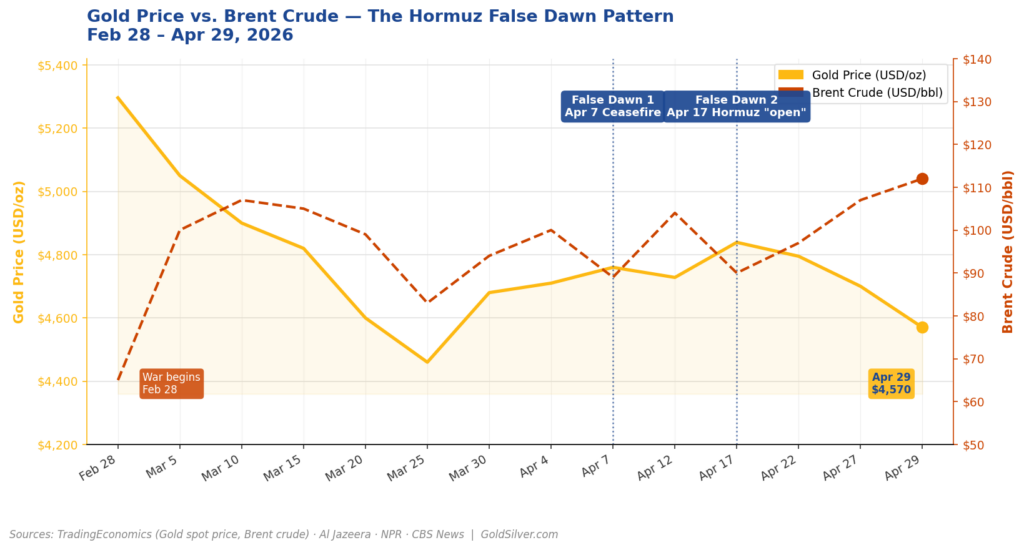
- Iran’s army confirmed today it is “still in a war situation.” The latest Hormuz proposal collapsed. Brent topped $112. Gold fell 2% to $4,570 — its lowest since late March.
- Gold is falling because oil-driven inflation keeps the Fed frozen, which keeps real yields elevated, which suppresses gold demand. That’s the mechanism. Not a loss of confidence in the metal.
- The Strait has reopened twice since February 28 and closed again both times. It’s a process with false dawns, not a single event. Gold’s structural floor — 863 tonnes of central bank buying in 2025, a $1.9 trillion US fiscal deficit — is unchanged.
Sixty days into the Iran war, gold is doing something that confuses a lot of investors: falling. Oil is above $100. A war is active. Inflation is running at 3.3%. By conventional logic, gold should be surging.
It isn’t — and the reason matters more than the price move.
As of April 29, 2026, gold is trading near $4,570 per ounce, down roughly 2% from Monday and nearly 19% below its all-time high of $5,589, set on January 28, 2026. Brent crude topped $112 on April 28 — up roughly 10% on the week — as Iran’s latest Hormuz proposal collapsed without a deal. This morning, an Iranian army spokesperson confirmed the country is “still in a war situation” (Al Jazeera, April 29, 2026).
Price down, oil up, war ongoing. That’s not a contradiction. It’s the same mechanism running for the second month straight.
What Happened This Week With Hormuz Negotiations
Iran submitted a new proposal on Monday, April 27: reopen the Strait in exchange for the US lifting its naval blockade, with nuclear talks deferred. The White House confirmed Trump reviewed it with his national security team.
Secretary of State Marco Rubio acknowledged the proposal was “better than what we thought they were going to submit.” Then he closed the door: “That fundamental issue still has to be confronted. That still remains the core issue here” (NPR, April 28, 2026).
On Tuesday, Trump posted on Truth Social that Iran was “in a State of Collapse” and wanted Hormuz opened “as soon as possible.” No deal followed. No second round of talks is scheduled.
This cycle has played out before. On April 17, Iran’s Foreign Minister declared the Strait “completely open” during the Lebanon ceasefire. Oil fell more than 10% in a session. Gold rose. Then the US held its naval blockade in place, Iran re-imposed restrictions, and the Strait closed again within days. Brent recovered all its losses. The same pattern — proposal, partial opening, collapse — unfolded after the April 7 ceasefire too.
The Edge Every Investor Needs Smarter precious metals investing starts here. The Nuggets Newsletter brings you essential market insights, Fed updates, global trends, educational videos, and much more.
Why Does High Oil Push the Gold Price Down, Not Up?
The answer is a four-step chain. Understanding it is worth more than watching any price chart right now.
Step 1: Oil keeps CPI elevated. March 2026 CPI came in at 3.3% year-over-year — the highest since May 2024. Gasoline alone surged 21.2% in a single month (Bureau of Labor Statistics, April 10, 2026).
Step 2: High CPI keeps the Fed frozen. Today’s FOMC decision is expected to confirm the third consecutive hold of 2026 at 3.50–3.75%. The March dot plot pencilled in just one cut for the full year. With oil at $112 and CPI at 3.3%, even that looks conditional.
Step 3: Rates on hold keep real yields elevated. Real yields — the inflation-adjusted return on government bonds — are the single most reliable short-term driver of gold prices. When they’re high, Treasuries offer a genuine return. Holding gold, which pays nothing, carries a real cost.
Step 4: Institutional money stays in bonds. The result is a ceiling on the gold price. Not a confidence crisis in gold — a rate environment the Fed cannot exit while oil stays where it is.
Goldman Sachs has quantified the relationship: each 25 basis point rate cut generates roughly 60 tonnes of new gold ETF demand within six months. Three cuts — which require oil to fall and CPI to moderate — would add approximately 180 tonnes. That sequence hasn’t started.
Goldman’s April 26 note set Q4 2026 Brent at $90 as the base case, nearly $30 above the pre-war level. In the upside scenario, where Hormuz stays mostly restricted for another month, Goldman flagged Brent averaging $120 in Q3. At that price, the inflation case for gold overwhelms the real-yield headwind entirely. The ceiling flips into a floor.
Is the Strait of Hormuz Reopening a Single Event or a Long Process?
The evidence of the last 60 days says: a process, with more false dawns ahead.
The Strait has been effectively closed since February 28, 2026, when the US and Israel launched Operation Epic Fury. It opened briefly on April 7 under the first ceasefire. It opened again on April 17. Both times closure resumed within days. The International Energy Agency has called it the largest supply disruption in the history of the global oil market — and disruptions of that scale don’t resolve on a press release.
Each false dawn follows the same gold price pattern. Oil falls, inflation expectations drop, rate-cut odds rise, real yields compress, gold spikes — then oil recovers and gold gives it all back. Recognising that rhythm is more useful than reacting to each diplomatic headline.
What hasn’t moved is the structural case. Central banks bought 863 tonnes of gold in 2025, the fourth consecutive year near double the pre-2022 average of 473 tonnes (World Gold Council). The US fiscal deficit is projected at $1.9 trillion for FY2026, with annual debt interest payments exceeding the entire defence budget (Congressional Budget Office). These aren’t headlines. They’re the floor.
When Hormuz eventually resolves — falling oil, cooling CPI, a Fed that can finally cut — the ceiling lifts. The move from $4,570 back toward the January high of $5,589 requires exactly that sequence. It hasn’t started. Nothing in the last 60 days has broken the case for it when it does.
What Should Gold Investors Watch This Week?
Thursday, April 30 — Q1 GDP, Core PCE, Employment Cost Index.
The Atlanta Fed’s GDPNow model was tracking Q1 growth at 1.24% as of April 21, down from 3.1% in late February. If the print confirms stagflation — slow growth alongside inflation above 3% — the Fed’s paralysis becomes structural, not temporary. Gold’s floor firms. The ceiling stays.
Brent above or below $110.
This is the level where the inflation-ceiling mechanism on gold stays fully engaged. A sustained move below $110 is when the rate-cut calculus starts to shift.
Iran’s language, not its proposals.
Today’s “still in a war situation” is not how a country nearing a deal talks. The signal to watch for is “permanent reopening framework” — not a single proposal the US will reject in 48 hours.
The forces behind gold’s nearly 40% year-over-year gain haven’t changed. The ceiling is real. The floor is real. Thursday tells us which one is doing more work right now.
Stay On Top of Gold & Silver Prices
Get important market alerts sent straight to your inbox.
SOURCES
1. Al Jazeera — Iran War Live: Iranian Army ‘Still in War Situation’; Gulf Leaders Meet
2. NPR — Deadlock Over Iran’s Nuclear Program and the Strait of Hormuz Cripples Peace Efforts
3. NBC News — U.S. Appears Cool on Iran Proposal to End War and Reopen Hormuz Without a Nuclear Deal
4. Bureau of Labor Statistics — Consumer Price Index, March 2026
5. TradingEconomics — Brent Crude Oil Price, April 28, 2026
6. TradingEconomics — Gold Spot Price, April 28–29, 2026
7. CBS News — What Is the Highest Gold Price in History?
8. Benzinga — Goldman Lifts Oil Forecast Again: Q4 Brent $90, Upside Scenario $120
9. Goldman Sachs Insights — Gold Is Forecast to Rise: ETF Demand and Rate Cut Framework
10. World Gold Council — Gold Demand Trends: Full Year 2025
11. Congressional Budget Office — The Budget and Economic Outlook: 2026 to 2036
12. International Energy Agency — Global Oil Supply Disruption Assessment, 2026 (verify current URL at iea.org)
13. Federal Reserve Bank of Atlanta via FRED — GDPNow Q1 2026 Estimate, April 21, 2026
By the GoldSilver Editorial Team — helping investors understand sound money since 2005. This article is for informational purposes only and does not constitute financial, investment, or tax advice. Always consult a qualified financial advisor before making investment decisions.
You May Also Like:
- Oil Hits $100 and OPEC Is Fracturing. Gold Knows Why
- How China Restricts Silver Supply Without Touching Silver
- Powell Press Conference: What It Means for Gold
- Iran Blinked — And One Word From Powell Decides What Happens Next
- COMEX Silver First Notice Day April 30: What to Watch
- What Warsh as Fed Chair Means for the Gold Price
- 5 Signals the Mainstream Gold & Silver Narrative Missed
- Before the Fed Speaks, Watch This Number for Gold