Silver Rises Over 120% YTD




Published: 03-11-2026, 04:45 pm | Updated: 03-11-2026, 03:05 pm
Gold and silver often move together. Both are precious metals. Both have served as money for thousands of years. And both tend to perform well during periods of inflation or financial stress.
But there’s one key difference investors quickly notice: silver is far more volatile than gold.
When gold moves, it tends to do so gradually. Silver surges harder in bull markets — and falls faster during corrections.
Understanding why this happens is essential for any investor considering silver. The volatility isn’t random. It’s structural. And once you understand the mechanics behind it, silver’s wild price swings start to make a lot more sense.
Why Is Silver More Volatile Than Gold? (It Starts With Market Size)
The most important reason silver is more volatile than gold comes down to market size.
While more silver exists above ground than gold by volume, what matters for price behavior is dollar value—and on that measure, the gold market dwarfs silver’s.
Because gold is far more valuable per ounce, the total investable gold market can absorb large flows of capital without moving much. Silver doesn’t have that cushion.
As Alan Hibbard puts it: “Dollar for dollar, gold can absorb more money without moving the price. Put that same money into silver, and the price moves much more dramatically.”
In practice, this means surges in investment demand push silver higher faster—and selling pressure pushes it lower faster. Everything gets amplified.
The Financial System Isn’t Safer — And You Know It As risks mount, see why gold and silver are projected to keep shining in 2026 and beyond.
Why Can’t Silver Supply Quickly Respond to Higher Prices?
Silver’s supply structure makes price swings even more extreme. Unlike gold, most silver isn’t mined from dedicated silver mines. Roughly two-thirds of global silver production comes as a byproduct of mining other metals—primarily copper, zinc, nickel, and gold.
That means when silver prices spike, miners can’t simply ramp up silver production. They would need to increase output of those other metals first.
In other words, silver supply is a passenger, not the driver.
Complicating things further, global silver mine supply has been relatively flat for years. There’s little slack in the system even under favorable conditions. When demand shifts quickly, prices have to absorb the full impact—because supply has no meaningful way to respond.
How Does Industrial Demand Affect Silver Prices?
Silver isn’t just a monetary metal — it’s also a critical industrial input. Today, roughly half of all annual silver consumption comes from industry, including:
- Solar panels
- Electronics
- Medical equipment
- Electric vehicles
This creates a unique dynamic. Industrial buyers don’t purchase silver primarily based on price. They buy it because they need it for manufacturing.
A solar panel producer that requires silver to build its product will buy it whether silver costs $25 an ounce or $50. Because silver typically represents only a small portion of overall production costs, manufacturers tend to keep buying even when prices rise.
That steady demand can add significant fuel to moves already underway. There’s another wrinkle many investors overlook: industrial silver is often consumed.
Gold used in jewelry or electronics can usually be recovered and recycled. But silver used in circuit boards, solar cells, and medical devices often isn’t economically worth reclaiming.
In many cases, it simply disappears from the available supply. Over time, that means industrial demand can quietly tighten the market in ways simple supply-and-demand models may underestimate.
How Do Futures Markets and Leverage Increase Silver Volatility?
Much of silver’s price discovery happens on futures exchanges like COMEX, where traders use contracts rather than physical metal.
These positions are often highly leveraged, which creates a powerful feedback loop:
- Small price moves trigger large gains or losses
- Margin calls force rapid liquidations
- Buying or selling pressure cascades through the market
What makes this especially pronounced in silver is the scale of paper trading relative to physical supply. The volume of futures contracts often represents many times the amount of physical silver available for delivery.
Because of this disconnect, prices can move sharply based on sentiment alone.
During periods of stress, physical silver can even trade at significant premiums to spot prices as buyers seek real metal instead of paper contracts. In bull markets, leverage accelerates the upside. During corrections, it can accelerate the downside just as quickly. Volatility feeds on itself.
For a deeper look at exactly how this mechanism works, Alan Hibbard breaks it down in, Why Silver Moves Like This — Understanding Silver Volatility
Silver Has a Split Identity
Silver is unusual because it behaves like two different assets depending on market conditions. Sometimes it trades like gold — a monetary safe haven responding to inflation fears, currency weakness, or financial instability.
One way investors track this relationship is through the gold–silver ratio — a simple measure of how many ounces of silver it takes to buy one ounce of gold. When the ratio is historically elevated, it often signals silver is undervalued relative to gold.
When it compresses, silver tends to move fast. As the infographic below shows, the ratio has swung dramatically across history — from a fixed 15:1 in ancient Rome to a peak of 125:1 during the March 2020 panic, before silver’s 2025 rally brought it back toward more normal levels.
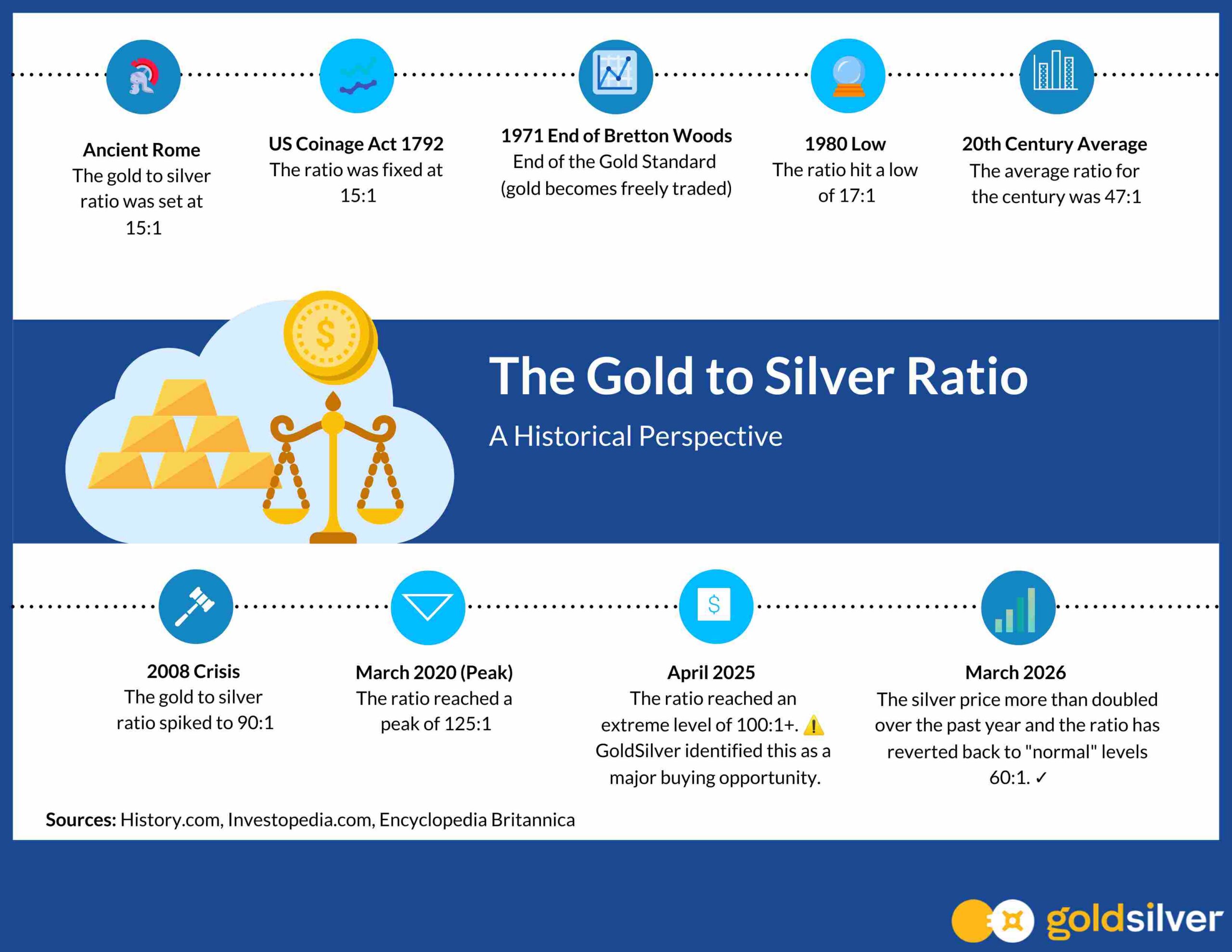
When these regimes shift — from monetary to industrial, from risk-off to risk-on — silver prices can move rapidly. That dual identity is one more reason silver is more reactive, and less predictable, than gold.
Who Should Invest in Silver?
Because of its volatility, silver tends to appeal to investors who:
- Want greater upside potential in precious metals bull markets
- Are comfortable with larger price swings
- Already hold gold as a more stable core position
Many experienced precious metals investors use a combination of both metals.
Gold often serves as the foundation of a portfolio, providing stability and long-term wealth protection. Silver, by contrast, can offer more explosive upside during periods of strong demand for precious metals.
The Bottom Line
Silver’s volatility isn’t a flaw — it’s a feature of the market.
Its smaller market size, rigid supply, heavy industrial use, leveraged trading, and dual role as both money and metal all contribute to dramatic price movements.
For investors who understand these dynamics, silver’s volatility can present opportunity. But it also requires patience — and the ability to tolerate bigger swings than gold.
That’s why many investors see gold and silver not as competitors, but as complements in a well-balanced precious metals strategy.
Stay On Top of Gold & Silver Prices
Get important market alerts sent straight to your inbox.
People Also Ask
Why is silver more volatile than gold?
Silver is more volatile because its market is much smaller than gold’s, meaning large investment flows move prices more dramatically. It also has strong industrial demand and a supply structure that doesn’t respond quickly to price changes.
Why does silver move faster than gold in bull markets?
Silver tends to rise faster during precious metals bull markets because its smaller market amplifies investment demand. When capital flows into metals, silver’s price can react more dramatically than gold’s. This is one reason many investors hold both metals as part of a diversified strategy.
How does industrial demand affect silver prices?
About half of annual silver demand comes from industry, including solar panels, electronics, and medical technology. Because manufacturers need silver for production regardless of price, industrial demand can support prices even when investment demand fluctuates.
Why can’t silver supply increase quickly when prices rise?
Most silver is produced as a byproduct of mining other metals like copper and zinc, not from dedicated silver mines. That means miners can’t simply increase silver production when prices rise—they would need to increase production of those other metals first. This rigid supply structure contributes to silver’s price volatility.
What is the gold-to-silver ratio and why does it matter?
The gold-to-silver ratio measures how many ounces of silver it takes to buy one ounce of gold. Historically, a high ratio can signal silver is undervalued relative to gold, while a falling ratio often coincides with silver outperforming. Many investors monitor this ratio when evaluating opportunities in precious metals.