Silver Rises Over 120% YTD




Published: 05-06-2026, 10:11 am
Gold and silver market update — May 6, 2026
Key Takeaways:
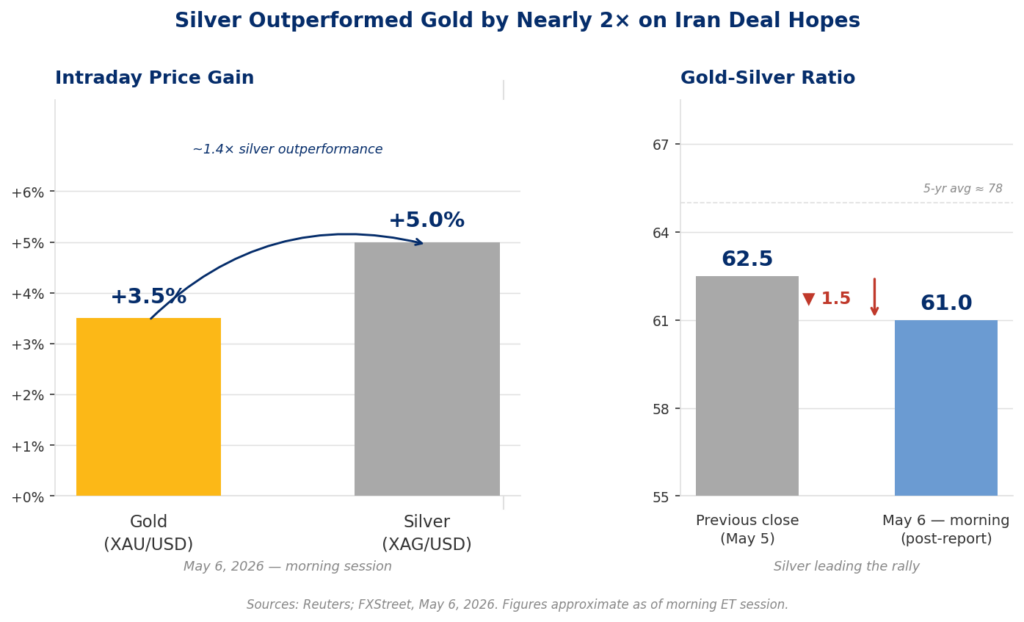
- Gold rose around 3.5% to near $4,700 and silver jumped around 5% to roughly $76–$77 on Wednesday, May 6, 2026, after Axios — citing two U.S. officials — reported the White House is close to a one-page peace memorandum with Iran.
- This isn’t a safe-haven trade. It’s the market pricing out the inflation mechanism freezing the Fed: closed Hormuz → high oil → high PCE → no rate cuts. A reopening runs that chain in reverse. Silver’s gain nearly doubled gold’s because a deal fires both its demand engines — monetary and industrial — simultaneously.
- The deal is not signed. Two prior peace signals reversed. Goldman Sachs ($5,400) and JPMorgan ($6,300) year-end targets hinge on exactly this inflation relief arriving. Watch Iran’s 48-hour response window and Friday’s jobs report.
Silver jumped around 5% Wednesday morning, May 6, 2026, to roughly $77 an ounce. Gold pushed toward $4,700, trading near $4,690 by mid-morning ET. The catalyst was an Iran deal report: Axios, citing two U.S. officials, reported that the White House believes it is close to a one-page peace memorandum — with an Iranian response expected within 48 hours. The gold price reaction was immediate.
Most coverage is calling this a peace trade. That framing is correct but incomplete. Gold and silver aren’t rising because a safe-haven bid is arriving. They’re rising because the mechanism suppressing both metals for ten weeks is leaving.
Why Is Gold Rising When Peace Should Hurt It?
De-escalation usually removes the safe-haven premium, so gold should fall. Today it didn’t — because this war trapped gold through inflation, not fear.
When Iran closed the Strait of Hormuz in early March, oil crossed $100 a barrel. That shock drove PCE inflation from 2.8% in February to 3.5% in March — the highest reading in nearly three years. As a result, ISM Manufacturing Prices Paid hit 84.6 in April, the largest three-month surge in the series. The Fed couldn’t cut rates into any of that. Markets now price just a 5% chance of a June cut, and real yields stayed elevated. Because gold yields nothing, it paid the price.
That is the trap. Not the war itself. The war’s inflation consequence.
A Hormuz deal breaks it. When the Axios report hit Wednesday morning, oil fell sharply. Lower oil cools PCE inflation. In turn, cooler PCE gives the Fed room to cut rates. Rate cuts compress real yields, and compressed real yields are the engine behind every major gold rally. So peace isn’t removing gold’s driver — it’s restoring it.
The Edge Every Investor Needs Smarter precious metals investing starts here. The Nuggets Newsletter brings you essential market insights, Fed updates, global trends, educational videos, and much more.
Why Is Silver Outperforming Gold Today?
Silver’s gain of around 5% is nearly twice gold’s, and the gap is meaningful. Silver has two demand engines — and this morning, both fired.
The monetary engine works the same as gold’s: lower oil, cooling inflation, and a Fed that can finally cut. Silver tracks gold tightly through this channel.
However, the industrial engine is silver’s alone. Two months of Hormuz closure disrupted global manufacturing — energy costs spiked, supply chains rerouted, and production fell. Silver demand fell with it. Indeed, the Silver Institute already projects a sixth consecutive annual silver deficit of 46.3 million ounces in 2026 (World Silver Survey, April 15, 2026). A Hormuz reopening doesn’t just lower oil — it also restores the manufacturing activity that drives silver’s largest demand category.
Consequently, the gold-silver ratio dropping from around 62.5 to roughly 61 in a single session confirms silver is leading this rally, not following it.
If a Deal Is Signed, What Happens to Gold’s Ceiling?
Goldman Sachs set a year-end 2026 gold target of $5,400 before the war and held it through ten weeks of conflict. Similarly, JPMorgan raised its target to $6,300 in February and held that too. Both forecasts shared the same premise: the Fed’s inflation constraint was temporary, and rate cuts were coming. The war extended that constraint month by month — delaying the thesis, not breaking it.
A Hormuz deal removes the oil shock from the inflation pipeline. As a result, PCE would cool toward 2.5–3% over the following two to three quarters. The Fed moves, and Fed rate cuts compress real yields — opening the $5,400–$6,300 band within 2026.
ActivTrades analyst Ricardo Evangelista said Wednesday that gold could reach $5,000–$5,500 by year-end if Hormuz normalizes. That isn’t a bull case outlier. It’s simply what the base case looks like with the headwind removed.
What Should You Watch in the Next 48 Hours?
The Axios window runs through Thursday night — one day before Friday’s nonfarm payrolls report. Consensus sits at approximately 53,000 new jobs, less than a third of March’s 178,000. Watch three signals: whether Iran publicly confirms it is reviewing specific deal terms; whether oil holds below $105; and whether Friday’s jobs print shows the labor market softening. A weak NFP, a live deal, and falling oil together would be the most favorable gold price setup since January.
The deal isn’t done, and this move could reverse — it has twice before. But the question has changed. It’s no longer “when does the inflation trap lift?” It’s “is this the moment?” That is a meaningfully different starting point.
Stay On Top of Gold & Silver Prices
Get important market alerts sent straight to your inbox.
SOURCES
1. Axios — Exclusive: U.S. and Iran closing in on one-page memo to end war
2. Reuters via CNBC — Gold climbs over 3% as Middle East peace hopes drag down dollar, oil
3. FXStreet — Silver price today: rises on May 6
4. UPI — Trump pauses Project Freedom less than two days after launch
5. Jerusalem Post — Rubio announces end of Operation Epic Fury
6. Silver Institute — World Silver Survey 2026
7. IEA — The Middle East and Global Energy Markets
8. U.S. Bureau of Economic Analysis — Personal Income and Outlays, March 2026
9. Institute for Supply Management — Manufacturing PMI® at 52.7%; April 2026 ISM® Manufacturing PMI® Report
Disclaimer: This article is for informational purposes only and does not constitute financial or investment advice. Always consult a qualified financial adviser before making investment decisions.
You May Also Like:
- What the IMF’s Inflation Forecast Shift Means for Gold
- What’s Really Driving Gold Prices Today — 5 Key Signals
- Gold Price and the Jobs Report: A Pre-Market Guide
- The Gold-Silver Ratio Is Expanding — and Being Misread
- Gold, Silver, and Stagflation: 5 Signals That Matter Now
- Why Gold Fell on the Hormuz Tanker Strike
- WGC Q1 2026: What Asia Knows That Wall Street Doesn’t
- BEA Stripped Silver From GDP. Here’s What It Means