Silver Rises Over 120% YTD




Published: 05-05-2026, 11:18 am
Gold is currently trading around $4,560 per ounce — roughly 18% below its all-time high of $5,589.38 set on January 28, 2026. Nitesh Shah, head of commodities and macroeconomic research at WisdomTree, forecasts gold could reach $5,500 by Q1 2027, driven primarily by the risk of central bank policy errors. With stagflation pressures rising and policymakers caught between inflation and recession, the structural case for gold remains firmly intact.
Gold surged approximately 65% through 2025 — its best annual performance in over four decades — closing the year near $4,310 per ounce. The rally continued into January 2026, pushing gold to an all-time high of $5,589.38 on January 28.
Since then, geopolitical turbulence in the Middle East has dragged prices back to around $4,560 as of early May 2026. The question investors are sitting with: is this a bull market catching its breath, or something more permanent?
One leading analyst thinks the former — and has put a $5,500 target on the table by Q1 2027. The force most likely to get it there? Central bank gold buying, and the very real risk that central bankers get their next policy call badly wrong.
What Is Central Bank Policy Risk — and Why Does It Matter for Gold?
Central bank policy risk means the danger that policymakers make a serious monetary misjudgment — overtightening into recession, or cutting too soon and reigniting inflation. Either outcome is historically bullish for gold.
That’s the bind right now. The Fed and its global counterparts are trying to contain sticky inflation without triggering a downturn. The margin for error is narrow. The tools are blunt. Raise rates too hard and you tip into recession. Cut too early and inflation reruns. Gold has historically risen in both.
Nitesh Shah of WisdomTree frames it plainly: “Central banks are fully cognizant that there’s not much they can do with interest rate policy without inflicting pain” — [Invezz]. That pain — stagflation, hard landing, or a currency credibility crisis — has historically driven capital toward the one asset that holds value without requiring anyone’s promise to back it.
Shah’s Q1 2027 forecast puts gold at approximately $5,500, which he describes as the conservative end of his range. Even in a pessimistic scenario — inflation back to 2%, dollar strengthening, bond yields rising — his model still lands gold around $4,630 per ounce. “Even with quite bearish assumptions, the downside is relatively capped,” Shah noted. Limited downside, meaningful upside.
Your Gold Buying Guide Most investors overpay when they buy gold. Then overpay again when they sell. This guide shows you exactly what to own — and why.
Why Are Central Banks Still Buying Gold in 2026?
Central banks purchased 863 tonnes of gold in 2025 — the fourth-largest annual total on record, and more than 80% above the 2010–2021 average of 473 tonnes per year — [World Gold Council, Gold Demand Trends Full Year 2025]. Yes, that was 21% below 2024’s pace. But the buying spanned more than 22 institutions. Poland led with 102 tonnes. Brazil re-entered the market for the first time since 2021. The breadth is the point: this isn’t one or two large buyers propping up demand. It’s a distributed, structural shift in how sovereign institutions manage reserves.
The underlying driver is de-dollarization. BRICS+ nations are reducing their exposure to U.S. Treasuries. Gold overtook U.S. Treasuries late in 2025 to become the world’s largest reserve asset by value. China’s People’s Bank, widely believed to be buying well beyond its disclosed figures, reported only 27 tonnes in official additions last year. Most analysts think the real number is substantially higher.
Sovereign buyers treat gold as policy, not as a trade. They don’t sell when the price drops. That price-insensitive, one-directional demand creates a structural floor that simply didn’t exist a decade ago — and it’s one of the core reasons the bull case for gold through 2027 remains intact.
Is $5,500 Gold by Q1 2027 Actually Realistic?
Yes — and institutional forecasts broadly support it, even if the path won’t be clean.
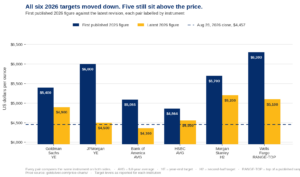
Shah’s $5,500 sits at the conservative end of what major banks are now projecting. J.P. Morgan forecasts gold averaging $5,055 per ounce by Q4 2026, rising to $5,400 by Q4 2027, based on combined investor and central bank demand averaging around 585 tonnes per quarter — [J.P. Morgan Global Research, Gold Price Predictions 2026].
Goldman Sachs has separately noted that if just 1% of the roughly $57 trillion in private U.S. Treasury holdings rotated into gold, it would send approximately $570 billion into a comparatively small market. That flow alone would be transformative.
The dollar angle is worth dwelling on. The DXY has been under sustained pressure as foreign governments reassess reserve allocations. A weaker dollar makes gold cheaper in every other currency — widening the pool of buyers and reinforcing price.
The risks are real and worth naming. A credible soft landing — inflation back to 2% without recession — would lift real yields and strengthen the dollar, removing two key tailwinds. Geopolitical de-escalation in the Middle East could reduce safe-haven demand near-term.
A major central bank publicly scaling back purchases would create a headwind. Even so, Shah’s bear-case floor of $4,630 contains the downside meaningfully. The question for long-term holders isn’t whether to own gold — it’s whether they own enough.
How Should Investors Position Now?
In a structural bull market, corrections are entry points.
Current prices near $4,560 represent a roughly 18% discount to January’s all-time high. That’s not a red flag — it’s how commodity bull markets breathe.
Start with physical. Bars and coins carry no counterparty risk. No issuer can default on physical gold. That’s the foundation of any serious allocation.
Consider ETFs for flexibility. U.S.-listed gold ETFs added 437 tonnes in 2025, pushing total holdings to a record $280 billion in assets under management — [World Gold Council, Gold Demand Trends Full Year 2025]. They offer efficient exposure without the logistics of storage.
Keep volatility in perspective. Gold pulled back 13–15% from its January peak in a matter of weeks. That’s not unusual — the 2025 run included multiple corrections of similar size before pushing to new highs. The 2025 bull run itself set 53 all-time highs. Pullbacks were part of it.
Policy uncertainty, monetary debasement, sovereign reserve diversification — none of these have changed. Middle East tensions and margin-related selling don’t touch the multi-year thesis.
Stay On Top of Gold & Silver Prices
Get important market alerts sent straight to your inbox.
People Also Ask
What factors are driving the gold price forecast toward $5,500 by Q1 2027?
The primary drivers are central bank policy error risk, sustained sovereign gold buying, a weakening U.S. dollar, and persistent inflation. WisdomTree’s Nitesh Shah argues the stagflation risk — where central banks damage growth while failing to contain prices — is underpriced in current gold valuations. He sees it as the most significant bullish catalyst heading into 2027.
How do central bank policies impact gold prices?
Central banks affect gold through two channels: direct purchasing, which creates demand, and interest rate policy, which influences real yields and the dollar. When policy dilemmas raise recession or stagflation risk, gold tends to benefit. Both risks are elevated right now.
Is $5,500 gold by Q1 2027 a realistic price target?
It sits within the range of credible institutional forecasts. J.P. Morgan projects gold at $5,400 by Q4 2027. WisdomTree’s Nitesh Shah places $5,500 at the conservative end of his Q1 2027 range. Both depend on continued central bank demand and sustained policy uncertainty — conditions that appear intact as of May 2026.
What role does inflation play in gold price increases?
Inflation erodes the real value of cash and fixed-income assets, making non-yielding gold comparatively more attractive. The effect is strongest when real interest rates are near zero or negative — which removes the opportunity cost of holding gold entirely. Several major economies are currently in that zone.
How does U.S. dollar weakness affect gold?
Gold is globally priced in dollars. A weaker dollar makes it cheaper for international buyers, widening demand and supporting price. It also signals broader concerns about U.S. fiscal and monetary credibility — the same concerns that drive demand for gold as a debasement hedge. That pressure hasn’t resolved.
So, Where Does That Leave You Right Now?
Gold is 18% below its all-time high. Central banks are buying at historically elevated levels. The analyst who called this rally most precisely is pointing at $5,500 by early 2027.
The pullback from January’s peak has felt uncomfortable — it always does. But uncomfortable and wrong aren’t the same thing. Policy uncertainty has deepened. The dollar remains under pressure. The sovereign buyers who hold gold as a reserve asset aren’t watching the daily price tick.
Whether $5,500 arrives in Q1 2027 or takes a little longer, the direction is clear. The question worth sitting with isn’t whether gold belongs in your portfolio — it’s whether you have enough of it.
If you’re thinking through your own position, GoldSilver.com is a good place to start.
SOURCES
1. Invezz — Central bank policy errors may drive gold to $5,500/oz by Q1 2027: expert
2. WisdomTree — Gold Outlook to Q2 2026
3. World Gold Council — Gold Demand Trends: Full Year 2025
4. World Gold Council — Central Banks: Full Year 2025
5. J.P. Morgan Global Research — Gold Price Predictions 2026: A New High?
6. Trading Economics — Gold Price Chart & Historical Data
7. Advisor Perspectives / WisdomTree — Gold’s Safe-Haven Status to Propel It to Significant New Highs
8. World Gold Council — Gold Market and Demand Trends Q1 2026
Disclaimer: This article is for informational and educational purposes only. It does not constitute investment advice. Please consult a qualified financial adviser before making any investment decisions.
You may also like:
- Why Gold Stabilizes — and Silver Amplifies
- COMEX Silver Coverage Ratio: Is Your Paper Silver Real?
- What the Gold Price Per Ounce Really Tells You
- The Gold Inflation Paradox Most Investors Miss
- Insurance vs. Upside: Balancing Your Portfolio with Gold and Silver
- Gold Bullion vs. Jewelry: Why Serious Investors Choose the Bar
- Gold & Silver IRA: Why Starting Early Costs You Less
- Silver Fair Value: What the Data and History Show