Silver Rises Over 120% YTD


Published: 11-05-2026, 02:48 pm | Updated: 11-05-2026, 03:10 pm
Research as of November 5, 2026
The 2027 gold and silver outlook depends on what each forecast measures. Some institutions expect lower annual averages, while others see a recovery later in the year. For physical owners, the useful questions are what drives those expectations and how ownership costs affect the result.
The important differences extend beyond price. Gold’s outlook depends heavily on monetary and investment demand. Silver also faces changes in industrial consumption, recycling, and supply. Those forces can pull the metals in different directions, even when both respond to the same dollar or interest-rate move.
This report compares selected, dated forecasts available in early November. It brings earlier coverage into context and explains what the numbers can tell someone holding coins or bars for years.
What are the key takeaways?
- The forecast period matters. A full-year average, a dated target and a risk scenario answer different questions.
- Silver’s supply story is changing. Metals Focus’s October 29 outlook projects a return to surplus in 2027. That remains a forecast.
- Gold demand has several sources. Central-bank purchases, exchange-traded funds and retail bullion demand can move differently.
- Spot-price gains are not your net return. Purchase premiums, resale spreads and ongoing ownership costs affect the result.
The Knowledge That Changes Everything
Two essential guides — yours free. Understand why gold matters and why fiat currencies always fail.
What are the main gold and silver forecasts for 2027?
The forecasts below are in nominal U.S. dollars per troy ounce. They do not adjust for inflation or include retail premiums on coins and bars.
Who is forecasting the average price for the whole year?
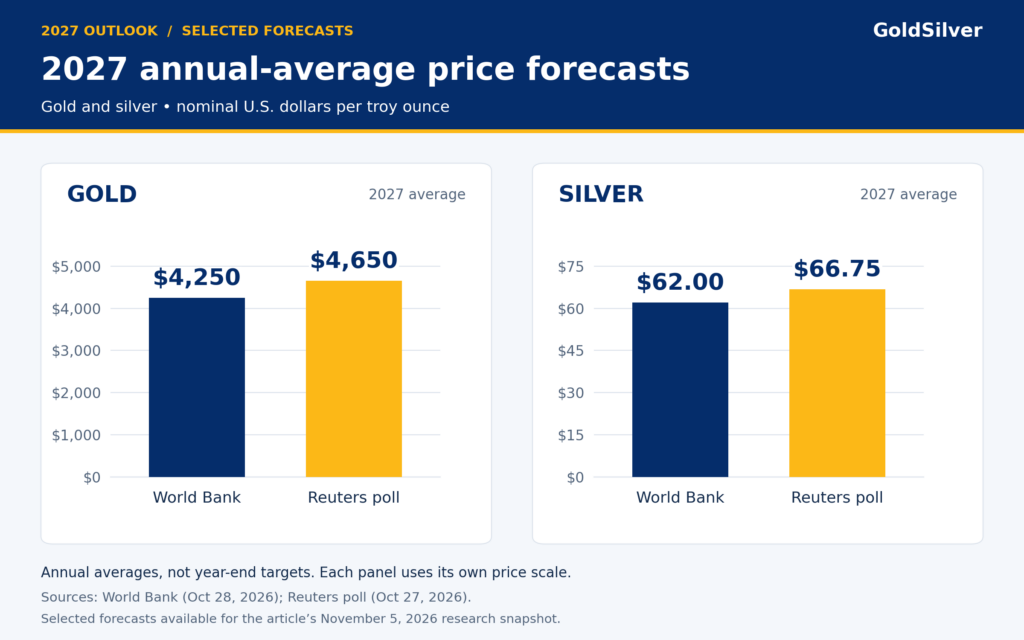
The World Bank’s October 28 outlook forecasts 2027 annual averages of $4,250 for gold and $62 for silver. Both are lower than its projected 2026 averages. That comparison does not describe the return from buying bullion today.
The October 27 Reuters poll points to higher 2027 averages: $4,650 for gold and $66.75 for silver. Its gold figure is the survey’s median forecast. These estimates describe average prices across the year, rather than year-end targets.
What do the models, targets and scenarios show?
UBS Chief Investment Office’s October 20 outlook targets $5,400 gold by September 2027. This describes an expected price at a particular point, so it cannot be compared directly with a full-year average.
WisdomTree’s October 29 gold model projects $4,789 by Q3 2027. Its October 22 silver model projects $70.55 for the same quarter. The gold model combines consensus macroeconomic inputs with WisdomTree’s own positioning assumption. These are conditional model outputs, not a survey of price targets.
State Street’s November monitor includes a bearish 12-month gold scenario of $3,750–$4,500. This is one risk scenario within its outlook, rather than its base case. It keeps the possibility of a weaker outcome visible alongside the higher targets.
Together, these outlooks show a range of possibilities. Their different periods and methods should be recognized, rather than averaged into one headline forecast.
Why can a lower annual average coexist with a recovery?
An annual average reflects prices throughout the year. A dated target describes an expected level at a particular point. A metal could begin 2027 weakly and recover later, yet still average less than it did in a stronger 2026.
The reverse also works. A strong first half could lift the annual average even if prices finish the year lower. Neither measure alone tells you the path between purchase and eventual sale.
For a physical owner, that path matters most when it intersects with a cash need. A five-year holding intention does not make a poor sale price harmless if money is needed in year two. Forecasts help frame uncertainty; they cannot settle your personal holding period.
What could support or weaken gold in 2027?
Gold’s monetary role gives it a different demand profile from an industrial commodity. It pays no interest, so the return available elsewhere matters. Its appeal also depends on how buyers assess currencies, financial assets and the value of holding bullion itself.
Why do real interest rates and the dollar matter?
A real yield measures a return after allowing for inflation. All else being equal, a higher real yield makes interest-bearing assets more attractive relative to non-interest-bearing gold. When it falls, the cost of forgoing that income declines.
Inflation alone therefore does not determine gold’s direction. If inflation prompts tighter monetary policy and higher real yields, gold can face pressure. If inflation expectations rise faster than nominal yields, real yields fall, which can reduce the opportunity cost of holding gold.
A stronger dollar can also make dollar-priced metal more expensive for buyers using other currencies. These mechanisms help explain why concerns about purchasing power do not produce a smooth upward gold price. The policy response and the currency move matter too.
What does the latest demand evidence show?
The World Gold Council’s November 3 report estimates 321 tonnes of net purchases by central banks and other official institutions in Q3 2026. Gold holdings in ETFs and similar products increased by 211 tonnes during the quarter. Bar-and-coin demand reached 268 tonnes, down 19% from Q3 2025. These are historical quarterly estimates, not forecasts for 2027.
A newer update, published November 5, reports a 19-tonne increase in global gold ETF holdings during October. That monthly figure is separate from the Q3 total.
The distinction is useful: official institutions and fund investors can support demand while retail bullion buying weakens. Strong central bank purchases do not mean every buyer is accumulating at the same pace. Nor do they remove the possibility of price declines if other demand fades.
For 2027, the question is how those sources of demand interact. Continued institutional buying could support prices. Higher real yields, a stronger dollar or weaker investment flows could offset that support. The ownership case deserves that full assessment rather than an assumption that one buyer group guarantees the outcome.
Is silver’s supply deficit story still the right starting point?
Silver’s industrial uses create demand, but they also expose it to manufacturing conditions and technological change. More installations of a silver-using product do not automatically require proportionately more silver. Manufacturers can reduce the amount used in each unit or substitute another material where practical.
The Silver Institute’s April 15, 2026 release, based on Metals Focus research, illustrates the distinction. Industrial silver demand fell 3% to 657.4 million ounces in 2025. Mine production rose 3% to 846.6 million ounces, while recycling increased 2% to 197.6 million ounces. These are 2025 estimates, not 2026 results or 2027 projections.
The newer outlook also warrants attention. In its October 29, 2026 weekly report, Metals Focus projects a narrowing deficit in 2026 followed by a return to silver market surplus in 2027. This challenges the assumption that recent deficits must continue. It does not establish that a surplus will occur or specify the price silver must reach.
A market balance compares supply with the demand categories counted in it. The World Silver Survey includes coin and net bar demand but reports exchange-traded product investment separately. Above-ground holdings and investors’ willingness to buy or sell also influence prices. A surplus does not force prices lower, and a deficit does not guarantee gains if available inventories meet the shortfall.
WisdomTree’s October 22 silver outlook captures the competing forces. Its model anticipates support from recovering gold prices while industrial headwinds, substitution and recycling constrain silver’s advance. The practical lesson is to examine both sides of silver’s demand, rather than treat industrial use as an automatic source of price growth.
How should our earlier forecasts be read?
Our gold forecast coverage and silver bull-and-bear analysis record how the debate developed. Each call still needs its original date and horizon. A 2026 target or a 2030 scenario cannot become a 2027 comparison simply by appearing in the same article.
Our September 22 coverage of Jim Rickards reported his $10,000 gold call for late 2026 or mid-2027. That is a dated individual outlook, not an institutional consensus. It shows the breadth of opinion without establishing the likelihood of that outcome.
The comparisons above therefore emphasize identifiable publications and clear forecast periods. Earlier calls remain part of the record, rather than silently becoming current forecasts.
What does the comparison mean for physical owners?
Gold and silver can serve related purposes without offering identical exposures. Gold’s monetary demand may remain resilient when manufacturing weakens. Silver can benefit from stronger industrial activity, but weaker consumption or faster substitution can work against it. Neither relationship guarantees how the metals will perform together.
The gold-to-silver ratio, calculated by dividing the gold price by the silver price using the same currency and weight unit, describes their relative pricing. It cannot tell you that either metal is cheap in absolute terms. The ratio can change because gold rises, silver falls or both move at different rates. It also says nothing about the cost of exchanging physical holdings.
For an existing owner, the useful question is whether the reasons for holding each metal still match the risks now visible. For a first-time owner, it is whether the position can withstand a disappointing year without forcing a sale. The largest forecast number does not answer either question.
How can a 10% spot gain become a 2.7% return?
Consider a hypothetical purchase containing $1,000 of metal at spot value. A 5% purchase premium makes the price $1,050. If spot subsequently rises 10%, the metal’s spot value becomes $1,100.
Suppose the dealer’s resale bid is then 2% below spot. You receive $1,078. The $28 difference from your $1,050 purchase price represents a holding-period return of approximately 2.7%, before any storage, shipping, insurance or taxes.
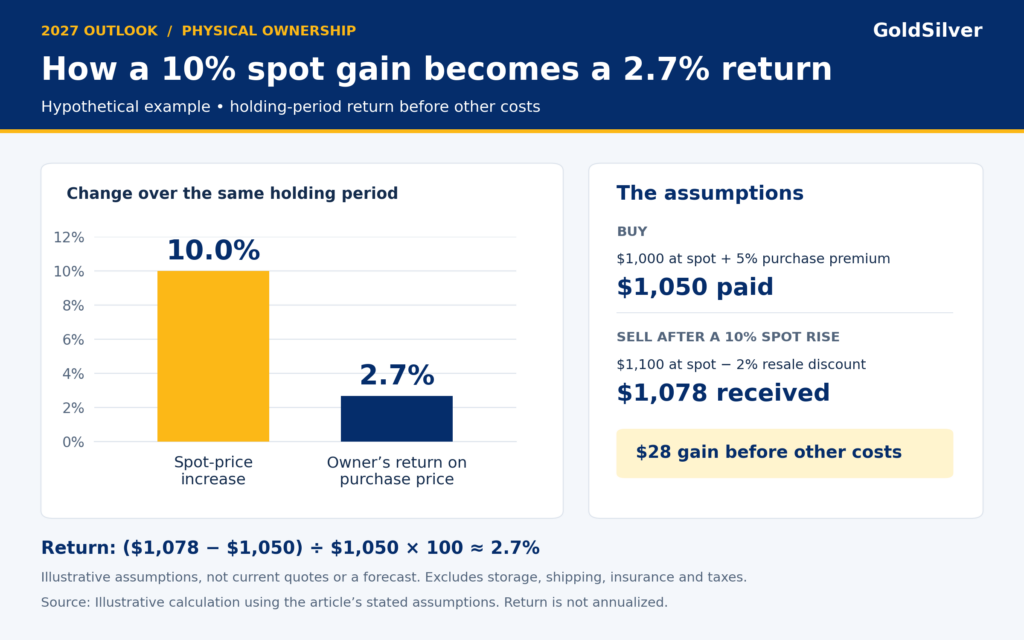
These assumptions are illustrative, not current quotations or a forecast. Different products and market conditions produce different premiums and bids. The example shows why understanding bullion premiums and pricing belongs beside any price outlook.
Physical ownership also involves a custody decision. Metal held outright has no issuer promising to repay principal, but that does not remove theft, loss, access or service-provider risks. Home storage and professional custody involve different responsibilities and costs. A long holding period gives those practical arrangements more time to matter.
What evidence would meaningfully change this outlook?
The next useful update is one that changes an assumption. Revised central-bank and investment-demand data could strengthen or weaken gold’s outlook. New industrial-use, recycling and inventory evidence could alter the silver balance. Changes in real yields and the dollar could affect both.
A forecast revision matters most when its explanation changes. A lower target caused by a different interest-rate assumption teaches something different from one caused by weaker physical demand. Keeping the institution, publication date, forecast period and reasoning together makes those changes easier to judge.
Stay On Top of Gold & Silver Prices
Get important market alerts sent straight to your inbox.
People Also Asked
No single figure represents all the sources in this report. Annual-average surveys, institutional targets, conditional models and risk scenarios use different methods. A useful comparison keeps those categories separate rather than combining them into one number.
No. Metals Focus’s October 29 projection is an expectation about 2027 supply and demand, not a certain outcome. Price also depends on investment demand and available inventories. The forecast weakens an automatic shortage argument without determining next year’s return.
Central-bank demand can support the market, but it does not guarantee a minimum price. Other buyers and sellers still matter, as do interest rates and currencies. Official purchases also do not determine what an individual bullion owner receives after costs.
No. Forecasts generally refer to market metal prices. Your sale proceeds depend on the product, metal content, condition where relevant, dealer bid and transaction costs. A purchase premium is not automatically recovered when you sell.
A higher target alone is insufficient. Its starting point, period and assumptions matter, alongside the risk of a disappointing outcome. Your intended holding period, access to cash, custody arrangements and ownership costs are also part of the decision.
The value of a 2027 outlook is a clearer understanding of what could change, including evidence that challenges the case. If that understanding leads to a practical ownership decision, our guide to how buying, storage and delivery work explains the choices involved.
SOURCES
1. CERN — ALICE Detects the Conversion of Lead into Gold at the LHC
2. GIA — Is There a Difference Between Natural and Laboratory-Grown Diamonds?
3. GoldSilver — Nobody Can Print Gold, and Mining an Ounce Ain’t Easy!
4. Marathon Fusion — Growing Fusion’s Fuel Supply While Co-Producing Gold
5. National Archives — Executive Order 11825: Revocation of Executive Orders Pertaining to the Regulation of the Acquisition of, Holding of, or Other Transactions in Gold
6. Federal Reserve Bank of Richmond — Gold and Silver: Frequently Asked Questions
7. The Royal Mint — Bullion Investing Jargon Buster
Disclaimer: This article is for informational purposes only and does not constitute investment advice. Past performance is not indicative of future results. Always consult a qualified financial advisor before making investment decisions.
You May Also Like:
- Gold Vault Storage: Inside a Brink’s Vault
- What Backs the US Dollar Today?
- Silver Price Outlook October 2026: Fed Hold Is Locked
- Gold Price Outlook October 2026: Pullback & Fed Decision
- Long-Term Gold Ownership: The Case for Holding Gold
- How Higher Silver Prices Can Create a Cash-Flow Squeeze for Recyclers
- Why Are Central Banks Buying So Much Gold in 2026?
- Proof Gold Coins: Same Gold, So Why the Bigger Price?