Silver Rises Over 120% YTD




Published: 05-12-2026, 03:46 pm
Gold is trading near $4,700 per ounce in May 2026. It set an all-time high of $5,589.38 on January 28 — and one of the world’s most respected fixed-income investors says the bull market has further to run. Jeffrey Gundlach, CEO and CIO of DoubleLine Capital and widely known as the “New Bond King,” has called gold the number one commodity he wants to own. He is urging investors to rethink portfolios built entirely on paper assets. His case rests on three forces that have been building for years and show no sign of reversing: currency debasement, U.S. dollar vulnerability, and relentless central bank accumulation. What follows is both his reasoning and a practical guide to acting on it.
Why Is the Bond King Watching Gold?
Jeffrey Gundlach founded DoubleLine Capital in 2009. He has since built one of the most closely followed macro outlooks in institutional finance. His move toward gold is not a response to short-term price action — it reflects a conviction that the financial architecture underpinning traditional portfolios is cracking.
Gundlach describes gold as a “real asset class.” The demand for it, he argues, is no longer coming from “survivalists” or “crazy speculators.” People are allocating “real money because it’s real value,” he said — and gold validated that by being the top-performing asset over the prior 12 months [Fortune]. For a man who built his reputation in bonds, that is a pointed observation.
Gold has moved from a fringe allocation to a strategic necessity — in a world of unsustainable U.S. debt, structurally challenged real interest rates, and central banks voting with their reserves.
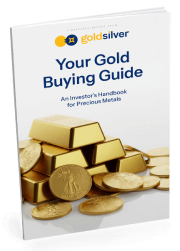
Your Gold Buying Guide Most investors overpay when they buy gold. Then overpay again when they sell. This guide shows you exactly what to own — and why.
What Is Gundlach’s “Radical” Diversification Portfolio?
Gundlach’s recommended portfolio is a deliberate break from the 60/40 model. That model, he argues, was designed for falling interest rates, manageable debt, and contained inflation. That world is gone.
In January 2026, he proposed a framework of 30% non-U.S. stocks, 20% real assets, 30% high-quality bonds, and 20% cash [Advisor Perspectives]. By March 2026, he refined the real asset sleeve to 15% — with 10% in gold and 5% in a commodity basket such as the Bloomberg Commodity Index. By May 2026, he raised the real asset allocation back to 20% in a Bloomberg interview [DoubleLine].
The logic holds across regimes. A portfolio spanning real assets, equities, fixed income, and cash is built to survive without requiring perfect market timing. Inflation benefits commodities and gold. Deflation rewards bonds and cash. Stagnation supports gold as a safe haven. No single scenario inflicts terminal damage on the whole.
Gundlach caps equities at 40% and fixed income at 25%. Market valuations are “incredibly high,” he says. Keeping 100% of a portfolio in paper assets is an asymmetric risk most investors are not pricing in.
What Are Gundlach’s Three Macro Triggers for Gold?
The U.S. Debt Trap
U.S. federal debt is on an unsustainable path. Servicing it at current interest rates places extreme pressure on the Treasury. M2 money supply reached $22.69 trillion in March 2026 — the 90.9th percentile of recent history — while the 10-year Treasury yield stood at 4.36% [247 Wall St.]. The refinancing math for Washington is punishing.
When governments can’t service debt honestly, they monetise it. They print money to cover obligations. That is precisely the environment in which gold has historically outperformed. For Gundlach, currency debasement is not a hypothetical — it is the operating assumption. Gold is not a speculative bet here. It is a mandatory hedge.
The U.S. Dollar Pivot
A structurally weaker dollar is one of Gundlach’s defining macro themes. The dollar’s reserve status is eroding as geopolitical fragmentation accelerates de-dollarisation globally. Since gold is priced in dollars, dollar weakness is a direct price tailwind.
U.S. inflation hit 3.8% in April 2026 — the highest reading since May 2023. That left the Federal Reserve stuck between fighting inflation and managing an economic slowdown [Trading Economics]. Long-term rates have barely moved despite prior cuts. For Gundlach, that is confirmation: the Fed cannot ride to the dollar’s rescue, and gold benefits directly.
Central Bank Accumulation
Nothing in Gundlach’s framework is more telling than what central banks are actually doing. Global central bank gold purchases totalled 863 tonnes in 2025. That was below the exceptional 1,000-plus tonne years of 2022 through 2024 — but still nearly double the 2010–2021 annual average of 473 tonnes. In the World Gold Council’s 2025 Central Bank Survey, 95% of respondents expected global official gold reserves to increase over the following 12 months. A record 43% signalled plans to expand their own holdings [World Gold Council].
These are not trades. These are multi-decade reserve management decisions. When sovereign institutions move at this scale and consistency, they are making a statement about fiat currency systems — and it is not a flattering one.
When Should You Buy? Reading Gundlach’s Entry Signals
Beyond the macro thesis, Gundlach is specific about when to act. Two signals stand out.
The $3,500 threshold. Gundlach has said he would buy gold “with both hands” on any pullback toward $3,500. Gold is currently near $4,700 — up from a 52-week low of $3,123 [Investing.com]. That gap matters. Pullbacks toward support are not reasons to panic. They are the buying opportunities Gundlach’s framework is built to capture.
The Gundlach Ratio (Copper/Gold). Divide the price of copper by the price of gold. Copper rises with economic growth; gold rises with economic fear. The ratio is therefore a real-time read on market confidence. Institutional asset managers use it as a leading indicator for the 10-year Treasury yield — a relationship Gundlach has cited publicly [CFA Institute]. When the ratio falls in an environment of sticky inflation, it is sending a specific signal: the economy is slowing but prices are not. That is historically one of gold’s best backdrops.
Gold vs. Silver — Which One Does Gundlach Prefer?
Gold is Gundlach’s primary focus. He calls it the “true monetary asset” — a store of value with a millennia-long track record that no government can replicate or debase. Gold is the core of his real asset sleeve. Everything else is secondary.
Silver is both monetary and industrial, which makes it behave differently across a bull market cycle. In early stages, silver typically lags gold. Once the precious metals move broadens, silver tends to accelerate sharply — offering greater upside with higher volatility. That makes it a complement, not a replacement.
How Should You Build a Gundlach-Inspired Portfolio?
The case for gold right now is not built on one catalyst. It is built on four that compound over time: inflation above the Fed’s 2% target, a weakening dollar, unsustainable federal debt, and central banks accumulating gold at historically elevated rates.
J.P. Morgan forecasts quarterly investor and central bank demand averaging 585 tonnes through 2026, with prices potentially reaching $5,000 per ounce by Q4 [J.P. Morgan]. Total global gold demand exceeded 5,000 tonnes in 2025 for the first time in history, valued at a record $555 billion [World Gold Council].
When the world’s foremost bond investor raises his real asset allocation to 20% and calls gold the number one commodity to own, that is worth taking seriously. The question is not whether to act — it is when. Waiting for the crisis to become obvious means paying the crisis price.
Stay On Top of Gold & Silver Prices
Get important market alerts sent straight to your inbox.
People Also Ask
Why does Jeffrey Gundlach call gold a “real asset”?
Gundlach distinguishes financial assets — stocks and bonds, which derive value from contracts and promises — from real assets like gold, which hold intrinsic value independent of any government or institution. In a world of currency debasement and rising debt, he views gold as an essential hedge against systemic financial risk.
Should I buy gold if it is already near all-time highs?
Gundlach’s answer is yes, if the fundamentals remain intact. He has said he would buy aggressively on any pullback toward $3,500. The forces behind the bull market — debt, dollar weakness, central bank demand — have not changed. In historical gold bull markets, prices above prior highs have repeatedly become new floors.
What is the Gundlach Ratio and how does it work?
The Gundlach Ratio divides the price of copper by the price of gold. Copper rises with economic growth; gold rises with economic fear. The ratio has historically tracked the 10-year Treasury yield with a strong directional correlation. Institutional asset managers use it as a leading indicator for interest rates.
Is the traditional 60/40 portfolio still valid in 2026?
Gundlach says no — at least not without restructuring. He caps equities at 40% and fixed income at 25%, dedicating 20% to real assets and the rest to cash equivalents. His view: equity valuations are “incredibly high,” and paper assets alone cannot protect purchasing power in a high-debt, above-target inflation environment.
How does central bank gold buying affect the gold price?
Central banks bought 863 tonnes of gold in 2025 — nearly double their pre-2022 annual average of 473 tonnes [World Gold Council]. That sustained institutional buying creates a structural price floor. J.P. Morgan projects combined central bank and investor demand averaging around 585 tonnes per quarter through 2026 [J.P. Morgan].
The Window Is Open — But It Won’t Stay That Way Forever
The convergence of signals Gundlach is tracking does not happen often. The world’s most respected bond investor is raising his real asset allocation and calling gold the number one commodity to own. Central banks are buying gold at nearly double their historical average. Total global demand has hit a record. Inflation is keeping the Fed pinned while the dollar quietly loses ground. All of this is happening simultaneously.
What makes the moment unusual is not just the direction of these trends — it is their durability. Debt does not unwind quickly. De-dollarisation is a decade-long process. Central banks do not reverse multi-year reserve strategies after a few months of price volatility. These forces do not turn on a headline.
Pullbacks Are the Point
No bull market moves in a straight line. Gold pulled back sharply from its January 2026 all-time high before recovering, and it will pull back again. Gundlach treats those dips as accumulation opportunities, not reasons to step back. The investors who tend to regret their decisions most are not the ones who bought during volatile stretches. They are the ones who watched the case build for years, waited for a “better” entry that never came, and missed the move entirely.
When you are ready to take that first step, opening a GoldSilver account takes a few minutes — and puts you in a position to act when the next pullback arrives, rather than watch it pass.
SOURCES
1. Fortune — ‘Bond King’ Jeffrey Gundlach says there’s no doubt ‘we’re in a mania,’ but gold is a ‘real asset class’
2. Advisor Perspectives — Bond King Reviews 2025, Offers Clues to 2026 in Webcast
3. DoubleLine — Gundlach Unlocked: Positioning for Inflation and a Weaker Dollar
4. 247 Wall St. — Jeffrey Gundlach’s Debt Restructure Trade: 2 Stocks and 2 ETFs Built for the Storm
5. Trading Economics — Gold Price
6. World Gold Council — Central Banks, Gold Demand Trends Full Year 2025
7. World Gold Council — Gold Demand Trends Full Year 2025
8. Investing.com — Gold Futures Price
9. CFA Institute Investor Blog — Is the Copper–Gold Ratio a Dependable Leading Indicator on Rates?
10. J.P. Morgan Global Research — Gold Price Forecast 2026 and Beyond
Disclaimer: This article is for informational and educational purposes only. It does not constitute investment advice. Please consult a qualified financial adviser before making any investment decisions.
You may also like:
- Gold Price Outlook May 2026: Why Institutional Forecasters Still See $5,000
- India’s ‘Patriotic’ Gold Buying Freeze: What It Means for Prices
- How to Time Your Gold & Silver Buys Using Technical Analysis
- Silver Jewelry or Bullion? A Buyer’s Guide to the Real Difference
- Gold and Oil Move Opposite Ways. Here’s Why That Matters
- 7 Timeless Warren Buffett Rules for Gold & Silver Investors
- Gold vs. Bitcoin: Which Hard Asset Will Protect Your Wealth?
- Why Central Banks Sell Gold — And What It Means for Prices